
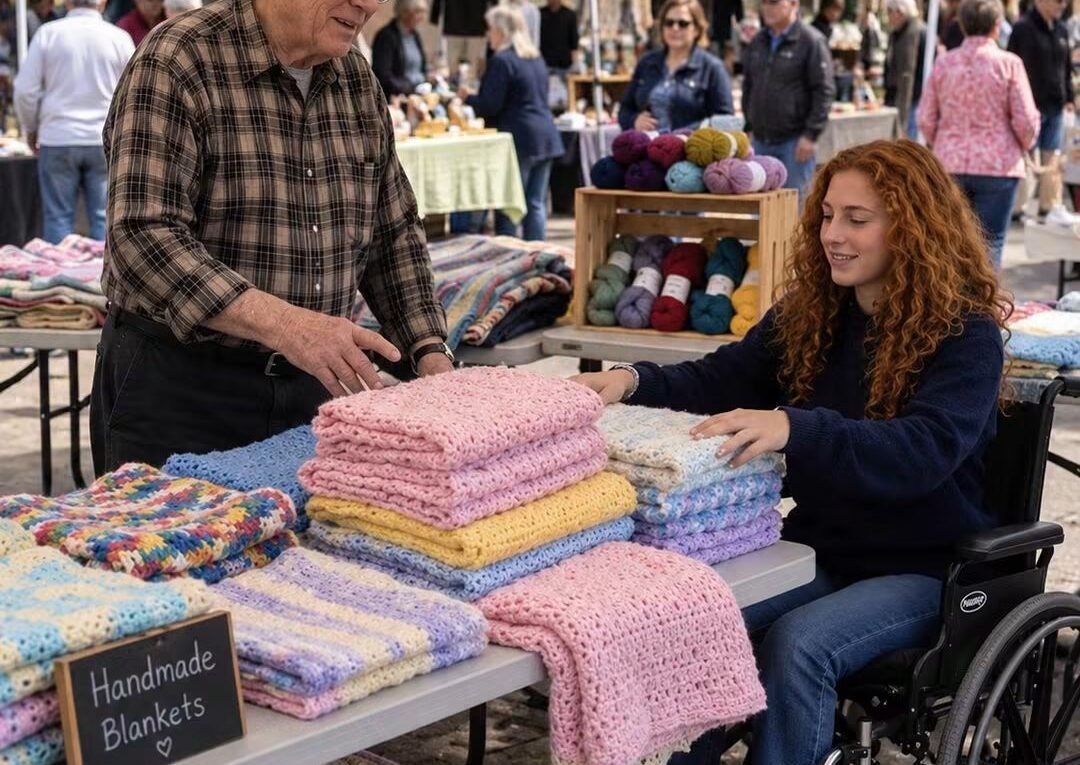
My 76-Year-Old Grandpa Sold Handmade Quilts at a Flea Market to Help Me Walk Again — Then a Biker Appeared and Said, “I’ve Been Looking for You for 20 Years”
16 – 20 minutes

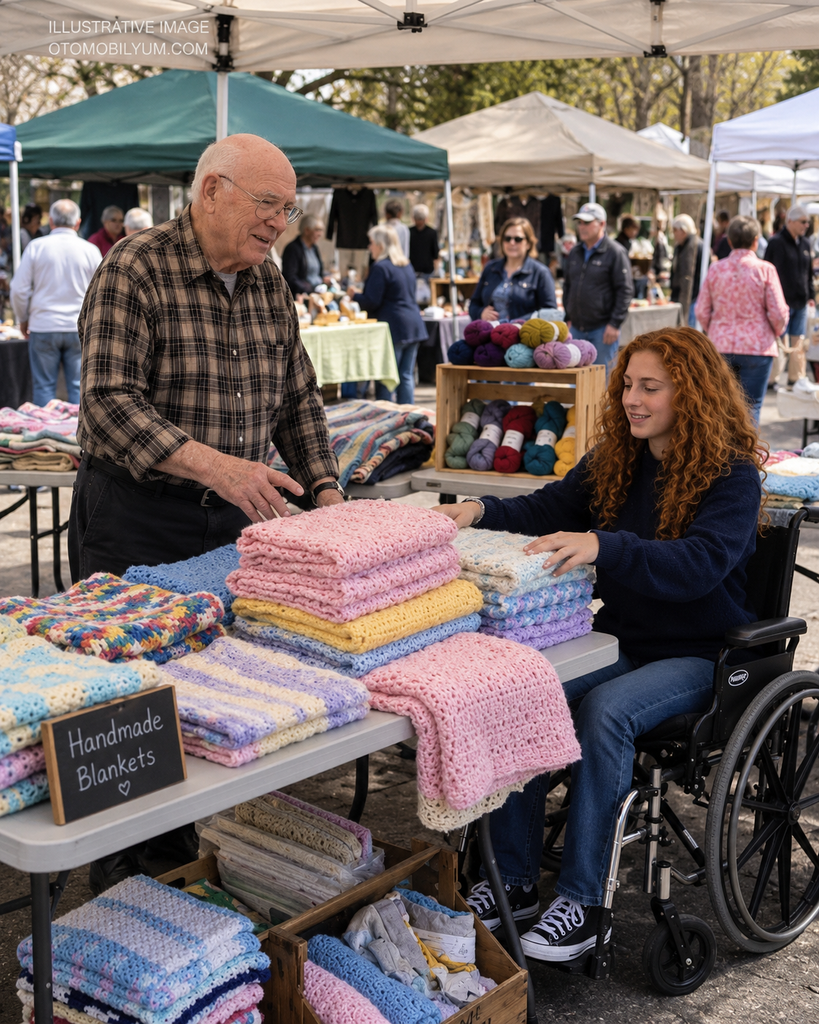
My grandfather’s hands were gripping the handles of my wheelchair when the biker looked straight at me and said:
“Your grandfather told me my daughter was dead.”
The entire flea market seemed to go silent.
A woman standing at our table slowly lowered the quilt she had been examining.
Someone at the next stall stopped packing boxes.
My best friend Tessa stood behind me with both hands covering her mouth.
I looked up at Grandpa.
He had raised me since the day I was born.
He packed my lunches.
He came to every school event.
He had even taught himself how to braid my hair when I was little.
And now his hands were frozen around my wheelchair.
“His daughter?” I asked.
Grandpa immediately tried to push me away from the table.
“Maisie, we’re leaving.”
I locked the brakes on my chair.
“No.”
His face tightened.
“Please, sweetheart.”
“You don’t get to hear something like that and wheel me away before I get an explanation.”
Across from us stood the biker.
He was probably in his forties, wearing a worn leather vest and a bandana, with faded tattoos running down both arms.
A minute earlier, I had been afraid he might hurt Grandpa.
Now he looked like he was trying not to cry.
“My name is Cole,” he said.
Then he looked directly at me.
“Hannah was the person I loved more than anyone.”
My throat tightened.
“My mother’s name was Hannah.”
“I know.”
Grandpa stepped between us.
“You have no right to come here.”
Cole reached into his vest and pulled out an old envelope.
“I’ve been looking for you for twenty years, Benjamin.”
His voice shook.
“I know what you did. And you’re not going to lie your way out of it anymore.”
He placed the envelope on our table.
Grandpa tore it open.
A photograph slipped out.
The moment he saw it, the color disappeared from his face.
“No…”
He stared at Cole.
“Is that really you?”
“It is.”
Grandpa’s fear suddenly turned into anger.
“How dare you come here after all these years?”
Cole clenched his jaw.
“You told me my daughter was dead.”
I grabbed the envelope before Grandpa could stop me.
Inside was a photograph of my mother.
She looked young.
Happy.
And standing beside her was Cole.
Mom was wearing a yellow floral dress.
I recognized the fabric immediately because Grandpa had used pieces of that exact dress in the quilt covering my legs.
I turned the picture over.
There was handwriting on the back.
My mother’s handwriting.
“Cole and me. Five years later. Maybe this time we’ll be brave.”
My hands started shaking.
“What does ‘five years later’ mean?”
Neither man answered.
I looked at Grandpa.
“Tell me.”
Cole finally spoke.
“Your grandfather decided I wasn’t good enough for Hannah.”
Grandpa snapped back:
“You had no job worth mentioning. No plan. Nothing.”
“I was twenty-one,” Cole said. “I was trying.”
“You would’ve dragged her into a life she wasn’t ready for.”
Cole laughed bitterly.
“So you made her choose between me and having a home.”
“I was protecting my daughter.”
Cole looked at me.
“He hid my letters.”
I stared at Grandpa.
“What letters?”
Grandpa wouldn’t meet my eyes.
Cole handed me another folded page.
Grandpa caught my wrist before I could open it.
“Don’t, Maisie.”
I looked down at his hand.
Slowly, he let me go.
I unfolded the letter.
It was from my mother.
“Cole,
If you’re reading this, something happened before I could fix things myself. Our baby is healthy and getting stronger every day. My father may never forgive you, but he has no right to erase you.
Hannah.”
I read it twice.
Then a third time.
The words didn’t change.
I looked at Cole.
“Are you saying I’m your daughter?”
His eyes filled.
“I’m saying Hannah believed you were.”
He paused.
“And I want proof too.”
Grandpa reached for my wheelchair again.
I slapped his hand away.
“Stop trying to move me every time you don’t like what I’m asking.”
“We should talk about this at home.”
“No.”
“Maisie—”
“No. Because at home you’ll tell me whatever version you want, and I won’t know what you left out.”
Cole nodded slowly.
“She’s right.”
I spread the papers across our flea-market table.
“Tessa, take pictures.”
Grandpa immediately objected.
“She will do no such thing.”
Tessa froze.
I turned toward her.
“You told me you weren’t going to disappear when things got hard anymore.”
She pulled out her phone.
For one desperate second, I still hoped Grandpa would tell me this was all some terrible misunderstanding.
But suddenly, I needed facts more than I needed comfort.
That was the first decision I made for myself.
A year earlier, my biggest argument with Grandpa had been whether fifteen was old enough to choose my own haircut.
Then came the accident.
Tessa was driving me home from school.
She was sixteen and overly careful behind the wheel.
The crash wasn’t her fault.
Another driver slid through a red light on a wet road and smashed into us hard enough to flip our car.
When I woke up in the hospital, I couldn’t feel my legs properly.
The first thing I asked was:
“Will I ever walk again?”
The doctor paused before answering.
“There’s a chance. But recovery will take time and a lot of physical therapy.”
Grandpa leaned forward immediately.
“Then schedule whatever she needs.”
The doctor looked uncomfortable.
“We need to discuss the cost.”
Grandpa barely hesitated.
“We’ll find the money.”
Insurance covered part of the treatment.
Not nearly enough.
But Grandpa refused to give up.
At seventy-six, he already worked long hours stocking shelves at a grocery store.
After my accident, he started taking extra shifts.
Then he pulled Grandma’s old sewing machine out of storage.
At night, he made children’s blankets and lap quilts.
On weekends, we sold them at the flea market.
One night, I found him sewing at two in the morning.
His fingers were swollen.
“You worked all day.”
“Your therapy comes first.”
“You matter too, Grandpa.”
He smiled as though that settled nothing.
Three days before Cole appeared, I was in physical therapy gripping the parallel bars.
My left knee buckled.
Grandpa immediately lunged toward me.
“I had it!” I snapped.
He stopped.
“I saw.”
“You moved.”
“My feet panicked.”
I almost laughed.
Then I noticed him breathing heavily.
“You worked another double shift, didn’t you?”
“I’m fine.”
“You’re rubbing your chest.”
He lowered his hand.
“This is too much.”
That evening, I took his sales notebook.
I raised the quilt prices.
I photographed everything.
I even started sketching smaller designs that would cost less to make.
Grandpa looked over my shoulder.
“You taking over?”
“I’m helping.”
He smiled softly.
“Just like Hannah.”
Any little detail about my mother felt precious to me.
I knew she had died shortly after giving birth to me.
I knew she liked yellow dresses, old music, and way too much cinnamon in her coffee.
About my father, I knew almost nothing.
Grandpa always said he disappeared.
Now I knew that wasn’t the entire truth.
After the flea-market confrontation, Tessa drove me home.
I went straight to my bedroom.
There was an old wooden box sitting on the highest shelf.
“Get that down for me.”
She handed it over.
Inside were photographs.
Cards.
And a bundle of letters tied together with string.
Every envelope had Cole’s name written across it.
Some had been returned.
Some had never even been mailed.
Then the front door opened.
Grandpa appeared in my doorway.
His eyes immediately went to the letters scattered across my bed.
“You had no right to open that box.”
I stared at him.
“You kept my whole life inside it.”
“I was protecting your mother.”
“From what?”
He stayed silent.
“Was Cole dangerous?”
“No.”
“Did he hurt her?”
“No.”
“Did he threaten her?”
Grandpa looked at the floor.
“No.”
I pointed at the letters.
“Then you weren’t protecting her. You were making decisions for her.”
“He had no future.”
“That was Mom’s choice to make.”
“She was eighteen.”
“And?”
“She was my daughter.”
I looked straight at him.
“And I’m your granddaughter. Does that mean you get to make all my choices too?”
His shoulders dropped.
I asked Tessa to give us a minute.
She stepped into the hallway.
Grandpa sat down beside the wooden box.
Then, finally, he told me everything.
Twenty years earlier, Hannah had been eighteen.
Cole was twenty-one, fixing motorcycles and taking whatever jobs he could find.
Grandpa hated the relationship.
“So you gave her an ultimatum,” I said.
He nodded.
“She could stay with you or leave with Cole.”
“I thought she would ruin her life.”
“And when he wrote to her?”
“I hid the letters.”
My stomach twisted.
“Then what does ‘five years later’ mean?”
Grandpa closed his eyes.
“She eventually found the letters.”
“And him?”
“Yes.”
“They got back together?”
“Yes.”
He swallowed hard.
“I didn’t know until she came home pregnant.”
“And then she died.”
His voice broke.
“Yes.”
I already knew what question I had to ask next.
“What happened when Cole called?”
Grandpa covered his face.
“He was driving back when he heard about Hannah.”
“What did you tell him?”
“I told him she was dead.”
“And me?”
His hands started shaking.
“I told him the baby died too.”
My throat tightened so much it hurt.
“Why?”
“I’d already lost my daughter.”
He began crying.
“I couldn’t lose you too.”
I stared at him.
“So you made sure he lost both of us.”
Grandpa cried harder.
And part of me wanted to comfort him.
That frightened me.
Because I loved him.
He had raised me.
He had worked himself sick trying to pay for my therapy.
But none of that changed what he had done.
“I love you,” I said.
He looked up.
“But loving you doesn’t mean I have to forgive you right now.”
“Maisie…”
“I can’t be around you.”
I rolled out of the room.
The next morning, Tessa drove me to meet Cole at a busy diner.
He had chosen a booth near the entrance.
He stood when he saw me.
Before he could say anything, I said:
“I’m not calling you Dad.”
“I didn’t ask you to.”
“You thought about it.”
He almost smiled.
“I’ve thought about a lot since Saturday.”
He slid a photograph toward me.
My mother was pregnant.
She stood beside a tiny knitted baby hat.
Under the photograph was a sheet of paper containing three possible baby names.
Mine was circled.
“You knew my name?”
“I knew the name Hannah wanted.”
I looked at him.
“But you never came back.”
“Your grandfather told me you were both dead.”
“And you believed him?”
Cole didn’t look away.
“I came back months later.”
I froze.
“What?”
“He had moved. Someone showed me Hannah’s grave. They told me there had been no separate funeral for the baby.”
“So you stopped looking?”
“For too long.”
“Why?”
“Because grief made me accept an answer I should’ve questioned.”
He took a breath.
“I failed you.”
The honesty hurt more than an excuse would have.
“How did you finally find us?”
“Hannah had left a letter with a friend. Benjamin told her the baby died too. Years later, she finally found me.”
He paused.
“Then I saw your picture on the flea market’s public page.”
“You recognized me?”
“I recognized Hannah in your face.”
I looked down at my hands.
“I want a DNA test.”
“Anything you need.”
“I’m serious. Grandpa has been my only family my entire life.”
“I understand.”
“The test can tell me whether you’re my biological father.”
I looked directly at him.
“But it doesn’t get to decide what kind of relationship we have.”
Cole nodded.
“That’s fair.”
A few weeks later, the results came back.
Cole was my biological father.
That didn’t magically make him Dad.
It didn’t erase fifteen years.
Grandpa remained my legal guardian.
And Cole promised there would be no custody battle.
“I already lost fifteen years,” he told me. “I’m not wasting the next three dragging you through court.”
I eventually allowed him to come to one of my therapy sessions.
When I reached for the parallel bars, Cole instinctively stepped toward me.
“Don’t.”
He stopped immediately.
Grandpa stayed back too.
He had already learned the rule.
I managed to stand for seven seconds.
Cole didn’t clap.
He didn’t tell me how brave I was.
He simply said:
“You worked hard.”
I smiled.
“Right answer.”
The following Saturday, I made Grandpa go back to the flea market.
“You lied here,” I told him. “You tell the truth here too.”
His hands trembled when he stood in front of the other vendors.
“Cole didn’t abandon Hannah,” he said.
People stopped what they were doing.
“I hid his letters.”
Grandpa swallowed.
“And after Hannah died, I told him his baby died too.”
One woman stared at him.
“You told us he disappeared when Hannah got pregnant.”
Grandpa nodded.
“I lied.”
He didn’t mention raising me.
He didn’t mention working double shifts.
He didn’t point toward the quilts and ask anyone to remember what he had sacrificed for my therapy.
He simply said:
“I loved Maisie. But I built part of that love around a lie. One doesn’t erase the other.”
That was the first moment I believed he truly understood.
Later, Cole offered to pay for all of my physical therapy.
I closed my notebook.
“I’m not a bill you can pay to prove you’re my father.”
He nodded.
“Then tell me how I can help.”
So I showed him something else.
The quilt designs I had been working on.
They were shorter lap quilts made for people who used wheelchairs.
I had designed easy-to-reach pockets.
Straps to keep them from sliding.
Shapes that wouldn’t catch around the wheels.
Cole studied the sketches.
“You made these?”
“During study hall.”
Grandpa leaned over my shoulder.
“I could sew a sample.”
“One sample,” I warned him. “Not twenty before breakfast.”
Cole laughed.
Then he tapped the material list.
“I could pay for the first batch and take the finished quilts to weekend markets.”
I narrowed my eyes.
“No strings?”
“No strings.”
“I’m tracking every dollar.”
“I assumed you would.”
I looked at both men.
“Some of the profit can go toward my therapy. If we earn more than we need, the rest goes toward helping someone else.”
Cole nodded.
“You make the rules.”
“I do.”
And that mattered.
It was my idea.
My choice.
Their help came because I allowed it.
A week later, Grandpa finished the first adaptive quilt.
I tested it.
Then I made him redo one of the straps because it slipped.
He sighed.
“You’ve become difficult.”
“I’ve become quality control.”
Cole took the sample to two weekend markets.
He came back with seven orders.
The first profits paid for two additional therapy sessions.
At the next appointment, I stood behind my walker.
Grandpa and Cole waited several feet away.
My left leg shook.
“You can stop,” Grandpa said.
“I know.”
I moved one foot forward.
One step.
Then another.
Cole didn’t rush toward me.
Grandpa didn’t either.
They waited.
For once, everyone waited for me to decide what I needed.
When I reached the other side, I dropped into the chair and started laughing before I could cry.
Cole crouched nearby.
“Can I hug you?”
I wiped sweat from my forehead.
“Not while I’m this sweaty.”
Grandpa smiled.
But he didn’t reach for me either.
That mattered more than either of them probably understood.
Later, Grandpa handed me money from another quilt sale.
I counted it twice.
He watched me.
“You don’t trust me.”
I looked at him.
“Not with the truth.”
His eyes dropped.
I put the money into my ledger.
“I love you, Grandpa.”
He looked back at me.
“But love doesn’t erase what you took from me.”
Then I glanced toward Cole.
“And a DNA test doesn’t automatically make you my father.”
Cole nodded.
Neither of them argued.
That was the biggest difference now.
For fifteen years, other people had decided what truth I was allowed to know.
They had decided who belonged in my life.
Who I should trust.
Who I should call family.
Now they didn’t get to decide what I forgave.
They didn’t get to choose what I forgot.
And they didn’t get to define what either one of them would become to me.
The truth had belonged to them for fifteen years.
What happened next belonged to me.