
A Valentine’s Dinner Was Supposed To Be Romantic — Until The Night Took A Turn No One Saw Coming.
Valentine’s Day had always held a quiet kind of meaning for me. It didn’t have to be extravagant or dramatic; even a simple dinner or a walk together could feel special if the intention behind it was sincere.
That year, however, my boyfriend decided to plan something far more elaborate than anything we had done before. When he told me he had made a reservation at one of the most elegant restaurants in the city, I was genuinely surprised. It wasn’t the sort of place we usually visited, the kind of restaurant where every detail seemed carefully designed to create an atmosphere of romance.
From the moment we stepped inside, it felt as though we had walked into a scene from a movie. Soft violin music drifted through the dining room, blending with the quiet murmur of conversations and the gentle clink of glassware. Candlelight reflected off polished silver and crystal glasses, scattering tiny sparks of light across the white tablecloths.
Everything about the place felt refined and deliberate.
I remember feeling touched by the effort he had put into planning the evening. We talked about work, laughed over small stories from the past week, and leaned toward each other across the table the way couples do when they feel comfortable and close. As the night unfolded, I caught myself thinking that this was one of those rare evenings when everything seemed to align perfectly.
For a few hours, it truly felt like a flawless Valentine’s night.
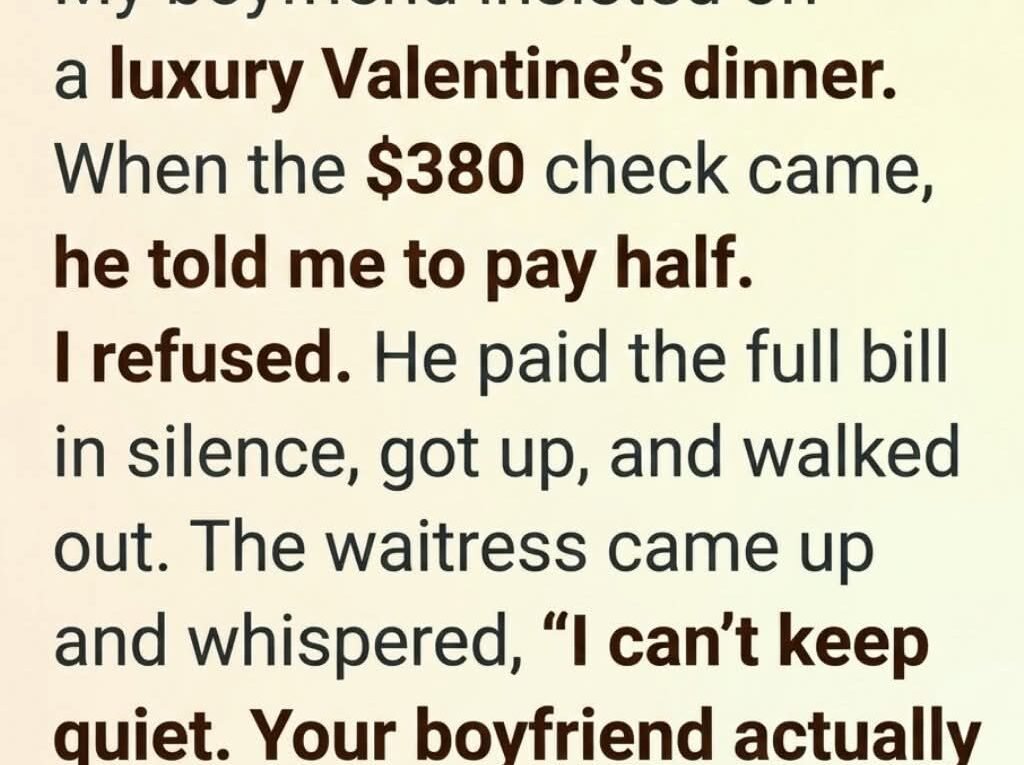
Then the bill arrived.


And the mood shifted in a way I hadn’t anticipated.
When the check was placed on the table, I glanced down almost absentmindedly. The total printed at the bottom caught my attention immediately.
Three hundred and eighty dollars.
For a brief moment I simply stared at the number, trying to process it. Before I could say anything, my boyfriend leaned forward slightly and spoke in a calm, almost casual tone.
“Let’s split it,” he said.
The suggestion surprised me more than the price itself. The entire evening had been his idea — the restaurant, the reservation, even the specific dishes he had encouraged me to try. I hadn’t expected the bill to become a shared responsibility, especially when I hadn’t been involved in choosing the place.
I took a moment before responding, wanting to phrase my thoughts carefully.
“I’m not really comfortable splitting something this expensive when I didn’t choose the restaurant,” I said gently.
I wasn’t angry or offended. I simply wanted to be honest about how I felt.
But honesty, even when spoken calmly, can sometimes change the atmosphere of a room.
For several seconds neither of us spoke.
The restaurant continued exactly as it had before. Music played softly in the background. Other couples laughed and leaned toward each other in quiet conversation. Waiters moved gracefully between tables carrying plates that looked like works of art.
Yet at our table, something had shifted.
My boyfriend didn’t argue or raise his voice. Instead, he nodded once, reached for his wallet, and paid the entire bill without another word. Then he stood up from his chair, turned toward the exit, and walked away.
There was no explanation.
No reassurance.
Not even a final glance in my direction.
I remained seated at the table, stunned by how quickly the evening had unraveled. My mind replayed the moment again and again as I tried to understand what had just happened.
Had I embarrassed him?
Had I responded too bluntly?
Or had I misunderstood the situation entirely?

The magical atmosphere of the restaurant suddenly felt fragile, as though the evening had been left unfinished.
When I finally gathered my purse and prepared to leave, unsure how to exit gracefully after such an awkward moment, the waitress approached me quietly.
Her expression suggested hesitation, as though she had been debating whether to say something.
“I’m sorry,” she said softly, “but I think you should have this.”
She handed me a small folded note.
“He asked me to give it to you after he left.”
My pulse quickened as I unfolded the paper.
The message inside was brief, but it had clearly been written with intention.
He explained that the evening had meant more to him than simply sharing dinner together. He had wanted to see how we would handle an uncomfortable moment — how we would react when something unexpected disrupted what had otherwise been a perfect night.
According to him, relationships are not truly defined by candlelight dinners or carefully planned dates.
They are revealed during the awkward pauses.
During the disagreements.
During the moments when two people must decide whether to react defensively or communicate honestly.
As I read the note again, I remained seated for several minutes, letting the meaning settle in.
Perhaps the evening had never been about the price of the meal.
Perhaps the bill had simply been a test of how we would navigate tension.
Would we withdraw into silence?
Would we become defensive?

Or would we try to understand each other even when the situation felt uncomfortable?
By the time I stepped outside into the cool February air, the tension that had filled my chest earlier had begun to fade. The night had not ended the way I expected, but maybe that wasn’t the point.
The experience had revealed something important about the way relationships grow.
Romance is not limited to candlelight, music, or beautifully plated desserts. Those moments can be lovely, but they are only part of the story.
Real connection is often revealed when things don’t unfold perfectly.
It appears in the willingness to express discomfort respectfully, to listen without becoming defensive, and to remain open even when a conversation becomes difficult.
That evening didn’t end with dramatic apologies or a cinematic reunion.
Instead, it ended with a quiet realization.
Sometimes the most meaningful moments in a relationship are not the flawless ones.
They are the imperfect moments that show how two people respond when the night stops going according to plan.