
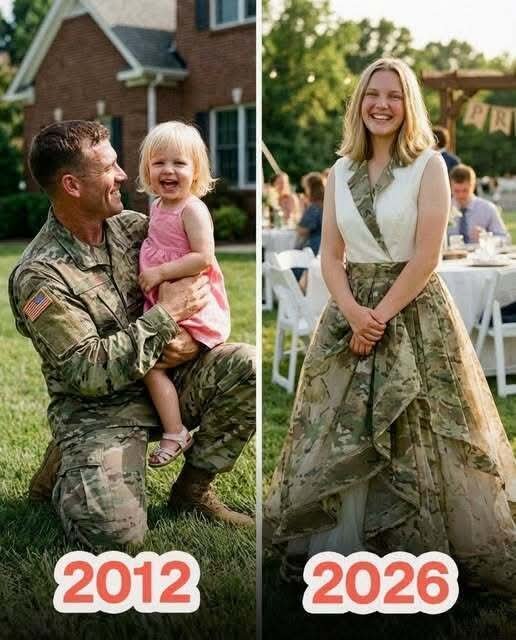
I Turned My Late Father’s Military Uniform Into a Prom Dress That Carried His Memory With Me, and What Happened That Night—From Hurtful Laughter to an Unexpected Knock at the Door—Changed Not Only How Others Saw Me, but How I Saw Myself Forever
Prom night is supposed to be simple. It’s meant to be about dresses, photos, music, and the kind of excitement that comes with stepping into something new. But for me, it never felt that way—not after losing my father. The idea of dressing up and celebrating without him felt incomplete, like something important was missing from the picture. In the weeks leading up to the event, while everyone else talked about colors and styles and trends, I found myself thinking about something entirely different. I wanted to carry a part of him with me. Not in a subtle way, not hidden or symbolic in a way only I would understand, but in something real—something I could see, touch, and feel. That’s when the idea came to me: I would make my prom dress from his old army uniform.
It wasn’t an easy decision. The uniform had been carefully stored away, folded with the kind of respect that comes with understanding what it represents. It held more than fabric—it carried years of his life, his service, his sacrifices, and the quiet pride he never spoke about but always carried with him. Cutting into it felt almost impossible at first. I remember sitting there with scissors in my hand, hesitating, wondering if I was doing the right thing. But then I thought about what he had always told me: that strength isn’t about holding on to things unchanged, but about finding ways to move forward while honoring where you came from. That thought gave me the courage to begin.
Each evening, after everything else in the house had quieted down, I worked on the dress. It wasn’t just sewing—it was remembering. Every stitch felt like a conversation I never got to finish with him. He had taught me how to sew when I was younger, sitting patiently beside me as I struggled to keep lines straight and tension even. Back then, it was just a skill. Now, it became something much deeper. As the dress slowly took shape, so did something inside me. I wasn’t just creating something to wear—I was rebuilding a sense of connection, of identity, of belonging that had felt lost for a long time. For the first time since he passed, I felt close to him again in a way that didn’t hurt as much as it healed.
When the dress was finally finished, I stood in front of the mirror for a long time. It wasn’t like anything I had seen before. It carried the structure of the uniform, but softened into something new—something personal. To others, it might have looked unusual, maybe even strange. But to me, it felt right. It felt like him. It felt like me. It felt like something I could be proud of. That confidence stayed with me until the moment I stepped downstairs and faced my stepfamily. Their reaction came quickly, and it wasn’t what I had hoped for. There were laughs, confused looks, comments that dismissed what I had created as odd or inappropriate. In that moment, the confidence I had built began to waver. It’s one thing to believe in something when you’re alone, and another to hold onto that belief when others challenge it.
I stood there, feeling exposed in a way I hadn’t anticipated. It wasn’t just about the dress anymore—it was about being seen, and not being understood. For a brief moment, I considered going back upstairs, changing into something more acceptable, something that wouldn’t draw attention or criticism. But then I thought about the hours I had spent creating it, about the meaning behind every detail, about my father and what he had represented in my life. I realized that if I walked away from it now, I wasn’t just changing clothes—I was letting go of something much more important. I took a breath, steadying myself, reminding myself that not everyone needs to understand something for it to matter.
Then came the knock at the door. It was unexpected, almost perfectly timed in a way that felt surreal. When the door opened, everything shifted. A military officer stood there, composed and respectful, holding documents and carrying a message that immediately changed the atmosphere in the room. The tone shifted from dismissive to uncertain, from casual to serious. As he spoke, it became clear that my father had made arrangements—thoughtful, deliberate steps to ensure that I would be taken care of, even after he was gone. It wasn’t just about finances or logistics. It was about intention. It was about him thinking ahead, making sure that I would have stability, support, and a future he wouldn’t be there to guide directly.
In that moment, something inside me settled. The laughter from earlier didn’t disappear, but it lost its weight. It no longer defined the moment. What mattered was what I understood now—that my father had believed in me, had planned for me, had cared enough to make sure I wouldn’t be alone in ways that mattered most. The dress I was wearing suddenly felt even more meaningful. It wasn’t just a connection to the past—it was a bridge between what he had been and what I was becoming. It carried both memory and momentum, something I hadn’t fully realized until that moment.
When I left for prom that night, I felt different. Not because everything around me had changed, but because something within me had. I walked with a sense of confidence that wasn’t dependent on approval or validation. It came from understanding my own story, from recognizing the strength I had built, and from accepting that not everyone would see things the way I did—and that was okay. The dress that had been questioned became a symbol, not just of my father, but of resilience, creativity, and self-expression. It represented the idea that meaning isn’t defined by others—it’s defined by the person who carries it.
Looking back, that night was never really about prom. It wasn’t about fitting in, impressing others, or meeting expectations. It was about standing in something that mattered to me, even when it was difficult. It was about learning that confidence isn’t the absence of doubt, but the decision to move forward despite it. And most importantly, it was about realizing that the people we lose don’t leave us empty—they leave us with pieces of themselves that we carry forward in our own way. That night didn’t just change how others saw me. It changed how I saw myself, and that made all the difference.