
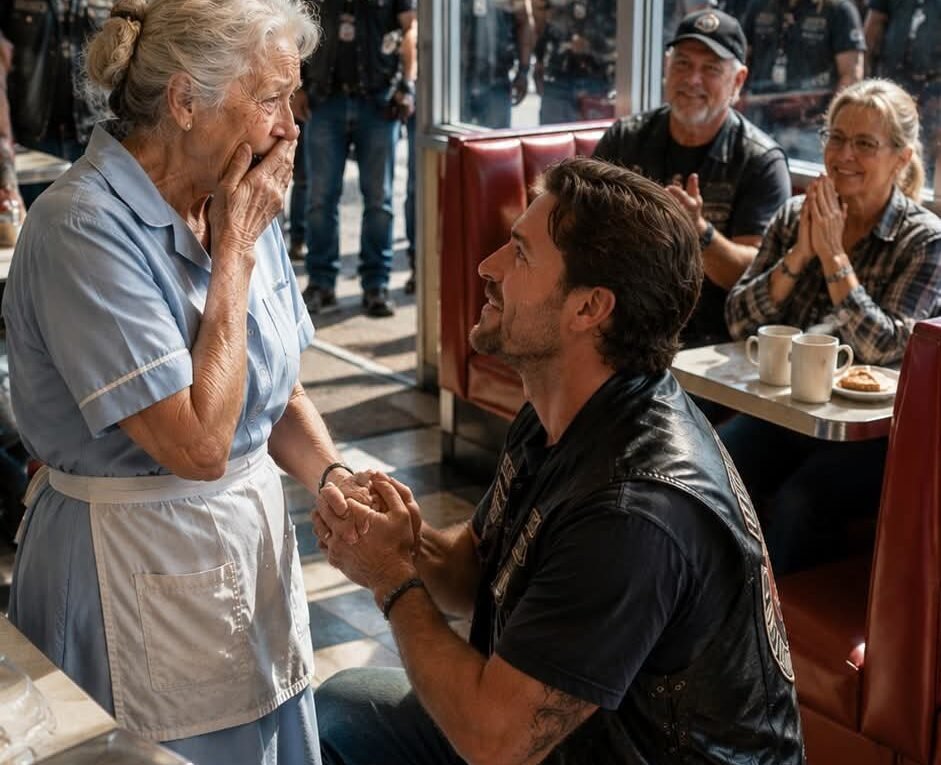
She Gave a Hungry Boy a Free Breakfast and Slowly Forgot All About It — Twenty-One Years Later, Nearly a Hundred Bikers Pulled Up Outside Her Diner, Leaving the Entire Town Convinced They Had Come to Cause Trouble, but the Truth Left Everyone Speechless.
The Morning Ninety-Seven Riders Came Back
The first sound came before anyone saw them.
It was low at first, like distant thunder moving across the flat roads outside Ashford Creek, Ohio. Then it grew deeper, rolling past the feed store, the old post office, and the little gas station on the corner until the front windows of Juniper’s Table began to tremble softly.
Inside the diner, June Merritt paused with a coffee pot in her hand.
She had owned the place for almost thirty years. She knew every regular truck, every delivery van, every school bus that passed by on County Road 18. But this sound was different.
One headlight appeared at the bend.
Then another.
Then another.
Within moments, motorcycles filled the road in front of her diner.
They did not speed. They did not show off. They moved slowly, respectfully, as if they were part of a quiet parade that already knew where it belonged.
The customers stopped eating.
A retired mailman lowered his newspaper. Two old friends in the corner booth forgot their checkers game. A young waitress named Ruby stood near the pie case with her mouth slightly open.
June set the coffee pot down.
Outside, the motorcycles parked one by one. The line stretched farther than the windows could show.
Someone whispered, “There must be almost a hundred of them.”
June did not count.
She only watched as the riders climbed off their bikes and stood in front of her little diner, helmets tucked under their arms.
Then one man stepped forward.
He was tall, broad-shouldered, and probably in his mid-thirties. His dark jacket was worn from years on the road. His boots carried dust. His expression was calm, but his eyes were full of something June could not name yet.
He opened the diner door.
The bell above it gave its familiar little ring.
For some reason, that tiny sound made June’s heart tighten.
A Stranger Who Remembered Everything


The man stood just inside the doorway and looked around.
He did not look dangerous. He did not look angry. He looked careful, almost gentle, as if he had stepped into a place he had carried in his memory for a very long time.
His eyes moved to the window booth near the front.
June followed his gaze.
That booth had been repaired more than once. The vinyl seat had a small patch near the edge. The table had a tiny wobble unless someone folded a napkin under one leg. But it was still the same booth she had wiped clean thousands of times.
The man looked back at her.
Then he said softly, “You gave me breakfast when I had nowhere else to go.”
The diner fell completely silent.
June’s hand moved to the edge of the counter.
She studied his face. The strong jaw. The road-weathered skin. The careful eyes.
And then, beneath the man standing before her, she saw the boy.
A thin boy in a faded hoodie.
A boy with wet shoes.
A boy who had stood outside that same window many years ago, too hungry to leave and too proud to ask.
June’s voice broke when she whispered, “It was you.”
The man nodded.
“Yes, ma’am. It was me.”

Twenty-two years earlier, Ashford Creek had been even quieter than it was now.
Juniper’s Table was never fancy. The sign above the door had faded from red to pink. The floor creaked near the register. The jukebox in the back worked only when it wanted to. But people came because the coffee was hot, the food was honest, and June treated everyone like they mattered.
She had one rule.
No one left hungry if she could help it.
She never put that rule on a sign. She never made speeches about kindness. She simply lived it.
If a farmer’s payment came late, she wrote his meal down and pretended to forget. If a high school student counted change too carefully, she added extra toast without saying a word. If a tired driver looked like he had been awake all night, she filled his cup before he asked.
Then, one gray October morning, she saw the boy.
He stood outside the diner window in a hoodie that was too big for him. His jeans were damp at the cuffs. His sneakers looked nearly worn through. He stared at the door, looked away, then stared again.
June knew that look.
It was not only hunger.
It was hunger mixed with shame.
She did not rush outside. She did not wave him in where everyone could see. She only kept wiping the counter and gave him time to decide for himself.
Finally, the bell above the door rang.
The boy stepped inside.
He stopped near the entrance like he expected someone to tell him he did not belong.
June smiled at him.
“Morning, honey. Looking for somebody?”
The boy kept his eyes low.
“No, ma’am. Just looking.”
June nodded toward the menu board.
“Well, that board has been stared at by half the county. You might as well sit down while you look.”
He swallowed.
“I don’t have money.”
There was no trick in his voice. No excuse. Just the truth, spoken like he already knew what came next.
But June did not point to the door.
She picked up a menu and said, “Good thing I asked if you were hungry, not if you were rich.”
His eyes lifted.
For the first time, he looked directly at her.
A Plate Given With Dignity
The boy slid into the window booth slowly, as if he still might be asked to leave.
June came over with her notepad.
“What sounds good?”
His eyes moved across the menu, but June could tell he was not reading the food. He was reading the prices.
After a long moment, he said, “Whatever costs the least.”
That sentence stayed with June for the rest of her life.
She clicked her pen and wrote down an order.
“One full country breakfast.”