
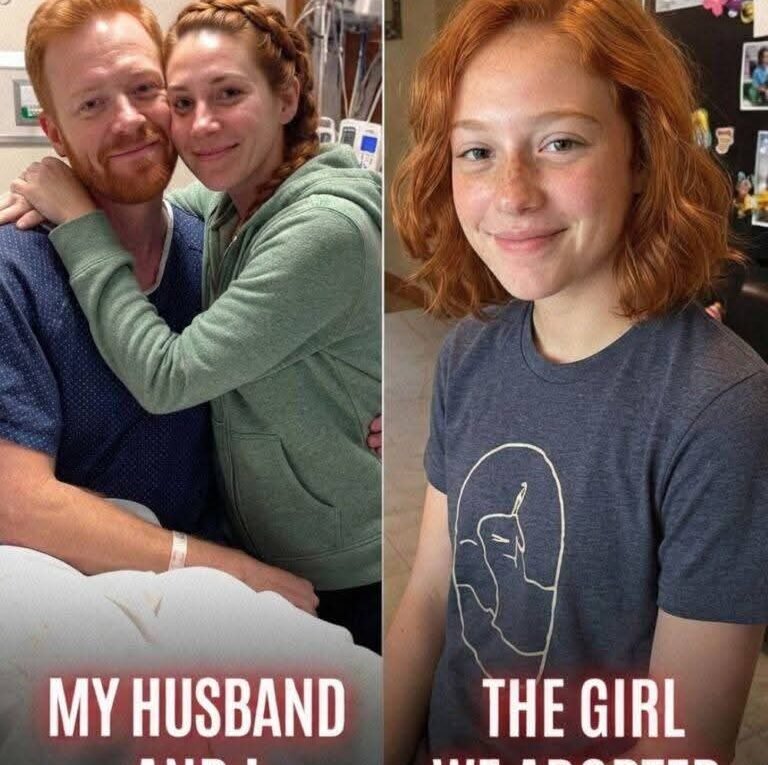
I Adopted a 16-Year-Old Girl to Fulfill My Late Husband’s Wish – Days Later, She Whispered, ‘It’s Time You Learned Who Your Husband Really Was’


Part 1: The Request
The morning the doctor said David had only weeks left, our home seemed to lose all sound.
For fifteen years, we had built a steady marriage and raised two children. I believed I knew him completely. But after the diagnosis, David became distant, staring at the ceiling with a fear deeper than his illness.
Whenever I asked what was wrong, he said he was tired.
Three weeks into hospice, he reached beneath his pillow and handed me an old photograph. A solemn sixteen-year-old girl stared back at me.
“Her name is Grace,” he said. “I need you to adopt her before I die.”
The request froze me.
I demanded to know who she was. David only asked me to trust him and said she had no one else.
“Is she your daughter?”
He closed his eyes as a tear slid down his cheek.
“Please don’t make me explain now. Bring her home first.”
I was angry and certain he was hiding a betrayal. Yet he was dying in front of me, and refusing his final request felt cruel. So I agreed.
Grace arrived during a rainstorm carrying one backpack. Our children welcomed her immediately, treating her like a sister before I understood why she was there.
That evening, I passed David’s room and heard him laughing for the first time in months. Grace sat beside his bed holding his hand. The tenderness between them made my stomach tighten.
Soon, I noticed they met privately whenever Grace returned from school. Their conversations stopped whenever I approached.
Once, I heard Grace whisper, “I can’t keep doing this.”
David answered, “Only a little longer. Please.”
When I confronted him, he promised I would understand later.
Later became the only answer he gave me.
Then I found Grace crying in the laundry room with her face pressed against one of David’s shirts. I begged her to tell me the truth, but she said she had made him a promise.
Three days later, David went to the hospital and never returned.
At the funeral, Grace stood beside my children. When people asked who she was, I said she was family, though I still did not know whether that was true.
Part 2: The Box
The night after the funeral, I lay awake counting every question David had left behind.
Near midnight, Grace appeared holding a wooden box.
“He told me to wait until the day after,” she said.
I asked her to leave it until morning, but she refused.
“I have spent my whole life as a secret. I cannot wait anymore.”
She sat beside me and placed the box between us. Inside were old letters and faded photographs. The first picture showed David’s father beside a young woman I had never seen.
“My mother,” Grace whispered.
On the back, David’s father had written one word: Forgive me.
Then Grace told me the truth.
David was not her father.
He was her half-brother.
Years earlier, David’s father had been involved with Grace’s mother. Grace was born from that relationship and raised in secrecy. Her mother died two years before David’s diagnosis, leaving a letter that led him to Grace.
For one moment, I felt relief. David had not betrayed our marriage with another woman.
Then Grace revealed that he had known about her before he married me.
For fifteen years, David had carried the secret while building a life with me. He claimed he was protecting his mother, who never knew about her husband’s betrayal. Even after both parents died, he remained silent.
The letters showed that David had supported Grace’s mother for years. After her death, he arranged Grace’s care, paid for school, and opened an account for her.
When he learned he was dying, he panicked at the thought of leaving her alone. Instead of telling me everything, he waited until he was too weak for an argument and asked me to adopt her.
“He used me,” I said.
Grace insisted he loved me and believed I was the only person kind enough to give her a home.
That made me angrier.
He had controlled when I would learn the truth and left me to handle the consequences after his death. He knew I would not refuse a dying man.
Grief hardened me.
I packed Grace’s clothes and placed her backpack by the door.
“You can return to Marta,” I said. “You have money. You are not my responsibility.”
Her face went pale.
“I never asked him to do this.”
“Neither did I.”
I told her that every time I looked at her, I would remember the years David had kept me blind. She picked up her bag and walked toward the stairs.
Before she reached the bottom, she collapsed onto a step.
Part 3: The Choice
Grace folded into herself and sobbed.
“I’m sorry,” she said. “I’m sorry I ruined him for you.”
Her words stopped me.
For the first time that night, I saw her not as David’s secret, but as a frightened sixteen-year-old girl. She had lost her mother, never been allowed to claim her father, and now lost the brother who had protected her from a distance.
“He did this,” I said. “Not you.”
Grace admitted David feared I would hate her. He had promised to carry the blame so she would no longer have to live in hiding.
Something inside me softened.
I sat beside her on the stairs.
“He was a coward,” I said. “But he loved you. He loved both of us in the wrong order.”
Grace wiped her face.
“I don’t want to replace anyone.”
“You couldn’t.”
Then I pulled her against my shoulder.
We cried for the same man from opposite sides of his lie. I mourned the husband I had loved and the honesty he denied me. Grace mourned the brother she had barely known and the family she feared she had lost.
My daughter appeared and asked whether Grace was leaving.
I looked at the backpack beside the stairs, then at the girl shaking in my arms.
“No,” I said. “She is staying.”
Grace released a breath that sounded as though she had been holding it for years.
Forgiving David would not happen quickly. Love did not excuse what he had done, and death did not erase the way he had manipulated my compassion.
But Grace was not his crime.
She was a child forced to carry the consequences of choices made before she was born.
In the weeks that followed, we began becoming a family. There were arguments, silences, and nights when anger felt stronger than grief. Grace answered my questions only when I was ready.
Slowly, I understood David had hidden her from shame over his father and fear of destroying his mother. Eventually, silence became easier than truth.
That explanation did not make his choices right.
It only made them human.
Grace stayed.
Not because David ordered me to keep her. Not because of the papers, the money, or his final wish.
She stayed because, when I could have sent her away, I understood that she had been betrayed too.
David had left us a broken truth inside a wooden box.
What we built from it afterward was our choice.