My Family Never Came For 4 Years
For four years, I had no family, no car, and no one willing to rearrange their life for my survival—except a man named Marcus.
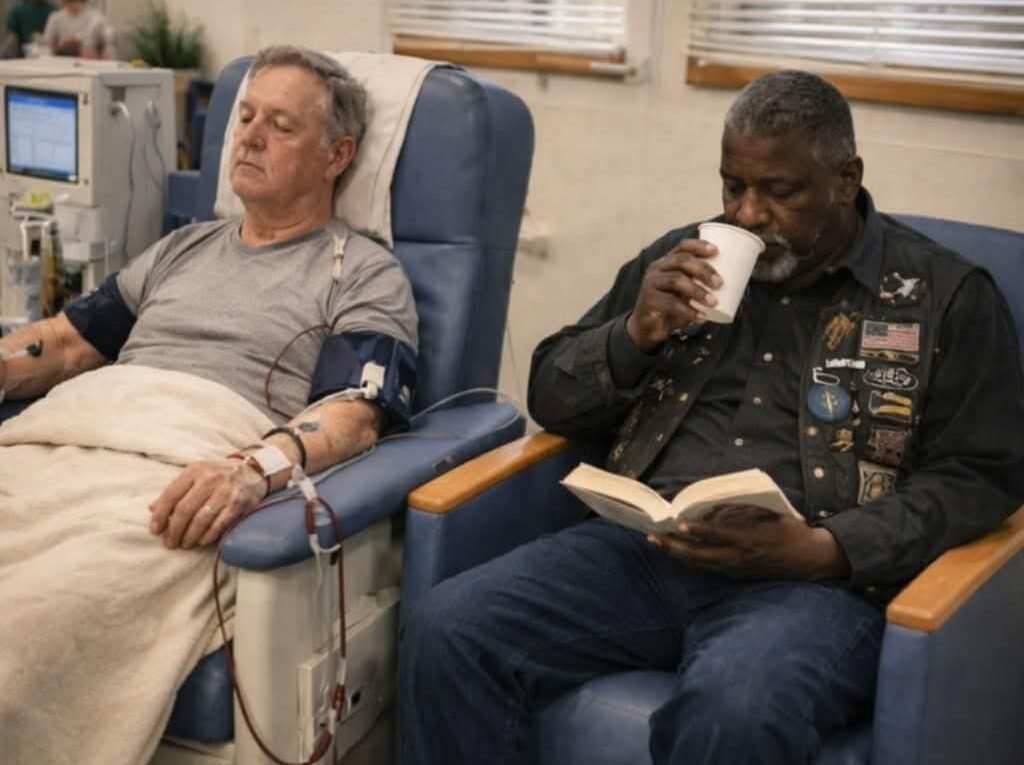
Three times a week, without fail, he picked me up before sunrise and drove me to dialysis. Marcus was fifty-eight, a military veteran, a widower, and a night-shift hospital custodian. He worked ten exhausting hours scrubbing floors so he could be free when my treatments began in the morning. He never missed a single session—not on holidays, not during snowstorms, not even when fatigue clung to him like a second skin.
He drank his coffee black, favored historical novels, and sat quietly in the visitor’s chair beside my dialysis machine with a steadiness that felt almost sacred.
My own family disappeared quickly. My daughter came twice before the distance and her children’s schedules became excuses. Eventually, she stopped calling. My son showed up once, scrolled through his phone for twenty minutes, and left before my blood cycle was finished. My ex-wife mailed flowers on my birthday, but they were already wilted by the time I returned home from treatment.
For a long time, my life felt reduced to hospital appointments and silent despair.
Then there was Marcus.
At first, I thought he had made a mistake. I assumed he was waiting for someone else. When I asked why he was there, he smiled gently and said, “To keep you company.” When I told him we didn’t know each other, he replied, “Not yet.”
Over the next four years, that “not yet” turned into something unbreakable. I learned how he took his coffee, his favorite authors, and the names of his two adult children. I learned he volunteered with multiple charities because staying busy was the only way he knew to survive the grief of losing his wife.
Marcus studied my kidney-friendly diet and brought me food I was actually allowed to eat. He read aloud when I was too weak to hold a book. We played hundreds of games of gin rummy, and he kept an ongoing tally of his wins. When my blood pressure crashed during a brutal session last year, it was Marcus who held my hand while nurses rushed in. My emergency contact was my daughter—but she never answered. Marcus was already there.
Last week marked four years on dialysis. Marcus handed me a card that read, “Four years of fighting. I’m honored to witness it.” I told him he didn’t have to keep coming, that I could manage on my own. That was when he finally told me the truth.
His wife, he explained, had died waiting for a kidney that never came. On the day he first noticed me at the clinic, I was reading the same historical novel she had been reading when she passed—marked at the exact same page. He believed it was a sign that he was meant to stay.
But the truth went even deeper.
Yesterday, while I sat in Chair 7 during my usual Tuesday session, a transplant doctor approached me. She told me a kidney had become available—not from the standard waiting list, but through a directed donation. Someone had requested that their kidney go specifically to me.
I was stunned. I had no one who would do that. When I asked Marcus if he knew anything, he fell silent. Later that evening, in my hospital room before surgery, he finally confessed everything.
Eight years earlier, exhausted after work, he had drifted into oncoming traffic and clipped another car. The driver survived but suffered severe internal injuries that led to permanent kidney failure.
That driver was my wife, Jennifer.
“I’m the reason she needed a transplant,” Marcus whispered. “I’m the reason she spent her final years on dialysis.”
He had attended her funeral from afar. When he later learned that I had developed kidney disease too, he couldn’t let history repeat itself. For four years, while driving me to treatments, he was also undergoing medical testing—hoping he could become my donor.
“I took your wife’s kidneys,” he said quietly. “Now I’m giving you mine.”
I wanted to rage. To scream. To hate him for the accident that destroyed my future. But all I could see was the man who never missed a day, who held my hand when everyone else disappeared. He had been repaying his mistake long before surgery ever became an option.
I told him Jennifer believed in forgiveness. I told him she would have let go of the anger years ago. And I asked him to move forward—not just for me, but for himself.
The surgery succeeded.
Six months later, I am no longer bound to a machine. I am living again. My daughter has returned, overwhelmed with regret for the years she missed. I haven’t told her the full truth yet. For now, it’s enough that she’s here.
Marcus and I still meet for coffee and cards. We visited Jennifer’s grave together recently. He stood quietly and whispered, “I’m taking care of him. I promise.”
We are two imperfect men who found healing in the most unexpected way. My family missed four years of my life, but Marcus never missed a moment. He taught me that showing up is the purest form of love—and that sometimes, the person tied to your deepest pain is also the one who helps you finally heal.