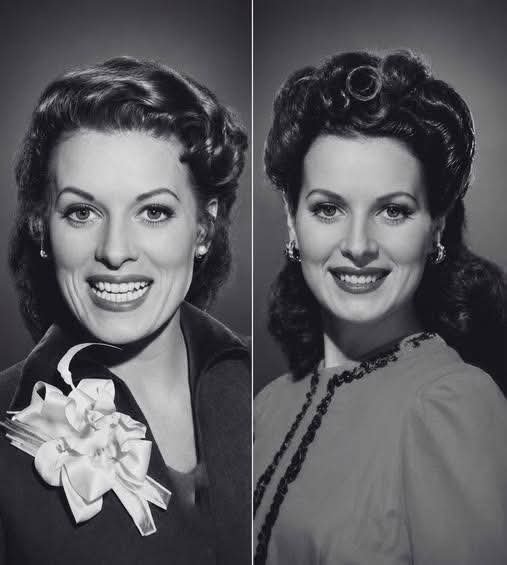
Maureen O’Hara…
8 – 11 minutes
A Girl From Dublin Who Was Never Meant to Be “Tamed”
Maureen FitzSimons was born on August 17, 1920, in Ranelagh, an affluent suburb of Dublin, Ireland.
She grew up in a loud, passionate Irish Catholic household where music, theatre, arguments, and laughter filled every corner of life. Nothing about her childhood suggested she would one day become one of Hollywood’s most iconic leading ladies—except perhaps her personality.
She was fearless long before fame ever found her.
As a child, she climbed trees faster than the boys, played football in the streets, and swam in cold Irish rivers without hesitation. She was strong-willed, competitive, and rarely intimidated by anyone.
Her family called her “baby elephant” — partly affectionate, partly amused by how unstoppable she was even as a young girl.
She was also the only redhead among her siblings, a feature that made her self-conscious at times. But insecurity never lasted long in her world. It disappeared the moment she stepped on stage.
By the age of fourteen, she had already earned a place at Dublin’s prestigious Abbey Theatre, where discipline and raw talent mattered more than reputation.
And there, something began to form that would define her entire life:
She did not bend easily.

The Screen Test That Changed Everything
At sixteen, she traveled to London for a screen test that, by her own later admission, went badly.
She was nervous. Awkward. Uncertain in front of the camera in a way she had never been on stage. The experience might have ended her ambitions before they even began.
But fate works in strange ways in Hollywood.
Actor Charles Laughton saw something in her that others missed—not softness, not glamour, but presence. A kind of inner fire that did not depend on approval.
He cast her in Jamaica Inn, directed by Alfred Hitchcock.
And he gave her a new name.
Maureen O’Hara was born.
A name that would soon become synonymous with strength, beauty, and defiance.
Hollywood Notices a Different Kind of Actress
O’Hara’s early success was almost immediate.
Within a year, she appeared in The Hunchback of Notre Dame, and not long after, How Green Was My Valley (1941), a film that would win Best Picture and establish her as an international star.
But even as her fame rose, something about her did not fit Hollywood’s expectations.
She was not fragile. Not submissive. Not easily controlled.
Studios expected actresses to be polished and compliant. Maureen O’Hara was neither.
She argued when necessary. She questioned direction when it felt wrong. And she refused to perform weakness she did not believe in.
That alone made her both valuable and “difficult,” depending on who was speaking.
John Ford and the Violence of Respect

One of the most complicated relationships in her career was with director John Ford.
Ford was a genius filmmaker—but also volatile, controlling, and known for pushing actors beyond comfort.
He admired O’Hara deeply. Possibly too deeply in his own contradictory way.
On one infamous occasion, during a production, he struck her in the jaw in front of the entire cast and crew.
The room froze.
Waiting for a reaction—tears, outrage, collapse.
But Maureen O’Hara did not give him what he expected.
She did not flinch.
She held her ground, eyes steady, refusing to be reduced to shock or submission.
That moment became part of Hollywood legend—not because of the violence itself, but because of what followed it:
nothing.
No breakdown. No surrender. No fear visible to the people watching.
It was the beginning of a reputation she would carry for decades.
She was not fragile.
And she would not be treated as if she were.
When the Industry Tried to Break Her
Hollywood in the mid-20th century was not just glamorous—it was controlled, image-driven, and often ruthless toward women who did not conform.
For O’Hara, that meant constant pressure to soften her personality.
To smile more.
To argue less.
To be “easier.”
But she did not adapt in the way they expected.
On another production, director John Farrow reportedly harassed and bullied her to the point of escalation. At one moment, he allegedly lunged at her with a riding crop.
That was the wrong line to cross.
O’Hara responded instantly—striking him in the jaw.
The incident ended the harassment immediately.
It also reinforced a truth that Hollywood slowly began to learn:
she was not someone you could intimidate into silence.
The John Wayne Years and a Different Kind of Partnership

In the 1950s, O’Hara’s on-screen partnership with John Wayne became legendary.
Together they starred in films like The Quiet Man, creating chemistry that audiences found unforgettable. On screen, they were opposites that fit perfectly—fire and force, pride and stubbornness.
Off screen, they shared mutual respect rooted in something rare in Hollywood: equality of temperament.
Wayne was a towering figure in American cinema, but even he respected O’Hara’s independence. She was not overshadowed. Not softened. Not rewritten to fit beside him.
Audiences loved her beauty.
But colleagues respected her backbone.
She did her own stunts when needed. She learned fencing and sword fighting for roles. She pushed physical performance further than most actresses of her time were expected—or allowed—to go.
She did not perform weakness.
She rejected it entirely.
The Scandal That Tried to Destroy Her
In 1957, a scandal magazine published a sensational story claiming Maureen O’Hara had been involved in an explicit incident in a Los Angeles theater.
It was the kind of story designed to destroy reputations in a single headline.
Many stars of the era would have quietly settled, paid, or disappeared until the attention faded.
Not O’Hara.
She fought back.
She sued.
In court, witnesses attempted to support the fabricated narrative. The case began to tilt toward damage control and reputational risk.
Then she did something no one expected.
She produced her passport.
Stamped dates. Official records. Travel documentation.
Proof that at the time of the alleged incident, she had been in Spain—thousands of miles away.
The courtroom shifted instantly.
The story collapsed under the weight of documentation.
And the magazine that published it never fully recovered from the damage of the lawsuit.
It was not just a legal victory.
It was a public reversal of power.
Love, Loss, and Reinvention
Later in life, O’Hara married Charles F. Blair Jr., a former Air Force brigadier general and pilot, whom she described as the love of her life.
For a time, she stepped away from Hollywood life and embraced a different world—aviation, travel, and partnership grounded in mutual respect.
But tragedy eventually came.
Blair died in a plane crash.
And instead of retreating into grief alone, O’Hara made a decision few expected.
She took over his airline company.
In doing so, she became the first woman in the United States to run a scheduled commercial airline.
It was not a symbolic role.
It was operational leadership in a male-dominated industry where she once again had to prove herself through competence, not permission.
Recognition That Came Too Late for Hollywood’s Memory

In 2014, at the age of 94, Maureen O’Hara finally received an Honorary Academy Award.
It was a lifetime recognition of a career that had spanned decades of iconic performances.
Ironically, she had never received a competitive Oscar nomination during her active years—despite being one of the most recognizable actresses of her era.
But by then, it hardly mattered to her.
She had never built her life around approval.
She had built it around endurance.
Around refusal.
Around the ability to stand firm when the world expected her to step back.
The Legacy of a Woman Who Did Not Yield
Maureen O’Hara’s story is not simply one of Hollywood success.
It is a story of resistance.
Against studios that wanted control.
Against directors who mistook strength for defiance.
Against tabloids that tried to rewrite truth.
Against systems that expected women to be smaller than they were.
She did not conform to Hollywood’s idea of what a woman should be.
She replaced it with her own definition.
Strong. Direct. Unafraid. Unbreakable when it mattered.
She was not remembered because she was easy to manage.
She was remembered because she was impossible to ignore.
Final Reflection
Maureen O’Hara lived through an era where image was everything and control was the currency of success.
And she refused to trade herself for either.
She stood her ground when it cost her comfort.
She fought back when silence was expected.
And she proved—again and again—that dignity does not require permission.
Some careers are built on fame.
Hers was built on resistance.
And that is why it still echoes long after the cameras stopped rolling.