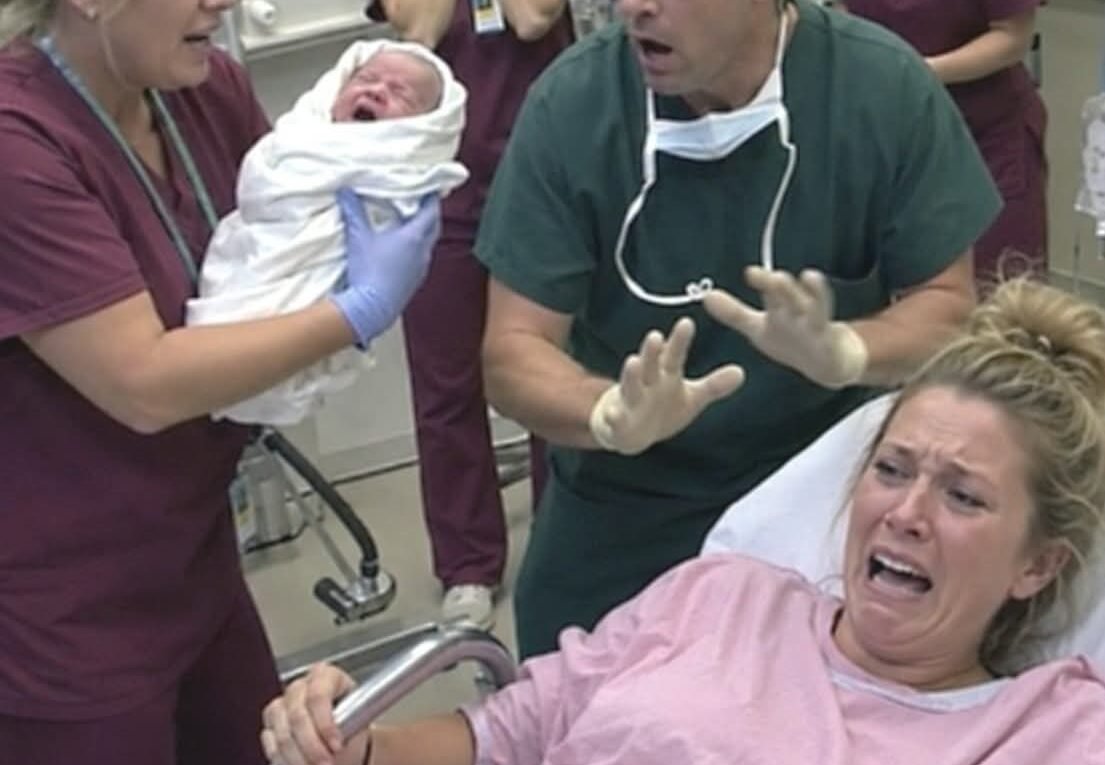
I was in labor carrying a 10-pound baby .
24 – 31 minutes
The sound did not belong in a room where a child had just been born.
One moment, there had been a cry.
Small. Furious. Alive.
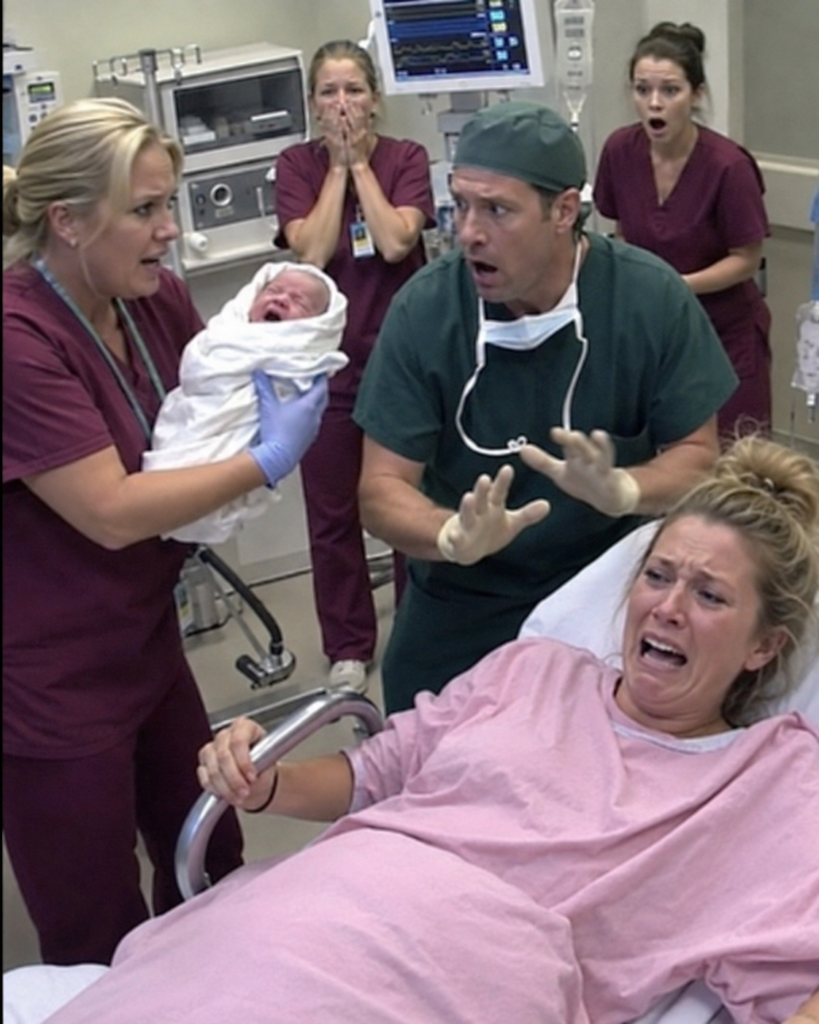
The next, there was only the flat, merciless alarm of a monitor insisting that something inside me had stopped keeping time with the world.
For a strange, suspended second, I could see everything with impossible clarity.
The surgical lights above me were too bright, ringed with halos. A nurse’s gloved hand hovered over my shoulder. Someone had wrapped my son in a pale blue blanket and turned away so quickly I saw only the curve of his cheek, pink and trembling, before he disappeared toward the warmer.
And Cameron—
Cameron stood frozen at the foot of the bed.
Not the composed obstetrician respected by half the hospital. Not the brilliant doctor whose calm had once made me feel safe during storms, blackouts, and the worst nights in the emergency department.
He looked like a man who had just reached for a door and found an abyss on the other side.
“Move,” someone snapped.
The voice cut through the alarm.
Dr. Elena Reyes pushed through the double doors, already in a sterile gown, her dark hair tucked under a cap, her eyes taking in the scene with terrifying speed.
She was the head of maternal-fetal medicine.
She was also the only person in that hospital who had never been afraid to tell Cameron Bennett he was wrong.
“What happened?” she demanded.
No one answered fast enough.
Elena’s gaze flicked from the monitor to my face, then to the sheet beneath me. Her expression changed by only a fraction, but I saw it. Recognition. Calculation. Urgency.
“Massive postpartum hemorrhage,” she said. “Get anesthesia back on. Two large-bore IVs. Type and cross. Call the blood bank now.”
Cameron seemed to jerk back into his own body.
“Elena, I had it under control—”
She didn’t even look at him.
“You don’t.” Her voice was not loud, but it landed like a door slamming. “Step away from my patient.”
My patient.
Not his wife.
Not his mistake.
My patient.
Those words followed me into the dark.
I did not remember closing my eyes. I remembered hands moving around me, quick and purposeful. I remembered someone saying my son’s Apgar score was improving. I remembered trying to ask if he was all right, but my mouth would not obey.
Then I remembered Cameron’s voice, close to my ear at last.
“Amelia,” he said. “Stay with me.”
It was the first time he had sounded afraid.
And all I could think, as the room slipped away, was that fear had arrived too late to be love.
When I woke, the world smelled different.
Not antiseptic and heat and panic.
Lavender.
Clean sheets.
A soft rhythmic beeping.
For a moment, I thought I was home. Then I tried to move, and a deep, aching heaviness pulled me back into the hospital bed.
My eyelids fluttered open.
The ceiling above me was pale gray. A curtain divided the room from the doorway. Beyond the window, dawn had begun to press a thin silver line over the city.
My throat felt scraped raw.
A nurse rose from the chair beside me so quickly her shoes squeaked.
“Dr. Grant?”
It was Maya, one of the labor nurses. Her usually neat bun was coming loose, and there were shadows beneath her eyes as if she had not slept all night.
I tried to speak.
Nothing came out.
Maya leaned closer. “Don’t force it. You were intubated for surgery.”
Surgery.
The word moved slowly through my mind.
There were gaps where memories should have been.
The flatline alarm. Elena’s voice. Cameron’s face.
Then one thought punched through the fog so violently my fingers clenched around the blanket.
My baby.
Maya saw the question before I could form it.
“He’s alive,” she said quickly. “He’s in the neonatal observation unit, but he’s stable. Ten pounds, four ounces. Strong lungs. A little bruised from the delivery, but he’s doing well.”
I closed my eyes.
The relief was so immense it hurt.
Tears slid down the sides of my face into my hair.
Maya pressed a tissue into my hand and, for a moment, said nothing. That silence was kinder than any reassurance.
When I opened my eyes again, I forced the words through the rawness in my throat.
“What happened?”
Maya looked toward the door.
It was only a glance, but I caught it.
Doctors learn to hear what people do not say. We learn to see hesitation, swallowed words, careful posture. Maya was not merely tired.
She was frightened.
“Dr. Reyes performed an emergency procedure,” she said. “You lost a lot of blood. There was uterine atony, tearing, and…” She stopped, choosing her words carefully. “There were complications from the length and difficulty of the delivery.”
My hand drifted to my abdomen.
There was pain there, but not the clean surgical pain of a planned cesarean. It was deeper. A battlefield ache.
“Did I code?”
Maya’s lips pressed together.
“For forty-seven seconds.”
Forty-seven seconds.
Less than a minute.
Long enough to leave a life behind.
Long enough for a husband to understand the meaning of a decision.
I stared at the window. Outside, the sky was turning blue, indifferent and beautiful.
“Where is Cameron?”
Maya’s expression tightened.
“He’s outside. He has been asking to see you.”
I waited for the familiar pull in my chest. The instinct to forgive before understanding. The reflex of seven years spent making room for his ambition, his long hours, his silences, his pride.
But all I felt was exhaustion.
Not hatred.
Not rage.
Something colder and quieter.
Distance.
“I don’t want him in here.”
Maya nodded once, as if she had expected that answer and respected it.
“I’ll let security know.”
Security.
The word made me turn my head.
“Why would security need to know?”
Maya hesitated again.
Before she could answer, the curtain moved, and Dr. Elena Reyes stepped into the room carrying a tablet and a paper cup of coffee gone untouched.
She looked tired in a way that made her seem more human than I had ever seen her. Her shoulders were stiff, her eyes red at the edges, but when she saw I was awake, her face softened.
“Amelia.”
I had worked beside Elena for nine years. We had disagreed over protocols, argued over staffing, and once spent three hours in a supply closet during a hospital lockdown calmly rationing granola bars and insulting hospital administration in whispers.
I had never seen her look at me with pity.
I did not want to see it now.
“How bad?” I asked.
She pulled a chair close to the bed.
“Elena.”
She sat down. “You survived because your body fought hard and because the team responded quickly once I arrived.”
“That is not an answer.”
A faint, humorless smile touched her mouth. “No. It isn’t.”
The beeping monitor filled the space between us.
Finally, she said, “You had significant hemorrhaging. We controlled it. You required transfusions. There was no hysterectomy.”
I absorbed that slowly.
No hysterectomy.
The possibility had been there, then. Close enough that she needed to name its absence like a blessing.
“And my son?”
“Currently charming every nurse in observation by refusing to sleep unless someone holds his hand.” Her voice warmed. “He is strong, Amelia.”
I covered my mouth, unable to stop the small broken sound that escaped.
Elena waited.
Then she placed the tablet on her lap.
“There will be a review.”
I looked at her.
“Of the delivery?”
“Of the delivery, the decisions leading up to it, the medication orders, and the conduct of everyone involved.”
The room seemed to sharpen.
“Medication orders?”
Elena glanced at Maya, who quietly slipped out and closed the door behind her.
When Elena spoke again, her voice was lower.
“Your epidural was discontinued without documented medical indication.”
“I know,” I said. “Cameron ordered it.”
“Yes.” Elena’s eyes held mine. “But that is not the only inconsistency.”
My fingers tightened around the blanket.
“What else?”
She inhaled carefully.
“Your chart shows a note entered shortly before active labor intensified. It claims you refused surgical intervention despite counseling.”
I stared at her.
“I never refused.”
“I know.”
“Who entered it?”
She did not answer immediately.
The silence was enough.
Cameron.
My husband had not only refused the procedure.
He had created a record that made it look as though I had chosen the risk myself.
For several seconds, I could not breathe around the pressure building inside my chest.
It was not panic.
It was the terrible effort of rearranging reality.
Seven years of marriage taught a person to excuse many things. Stress. Pride. Exhaustion. Miscommunication.
But there were decisions that could not hide behind those words.
A forged note was not confusion.
It was intention.
“Why?” I whispered.
Elena’s face changed again.
Not pity this time.
Concern.
“That is what we need to understand.”
I laughed once, but there was no humor in it. The sound hurt my throat.
“Sophie.”
Elena’s eyes flickered.
“You know about her?”
“I know she was in the room. I know she lied. I know Cameron believed her.”
Elena leaned back slightly. “What did she lie about?”
I told her.
Not dramatically. Not with tears. I simply described Sophie leaning close, nails pressing into the soft inside of my arm, the medication tray clattering, the immediate transformation of her face into wounded innocence.
Elena listened without interrupting.
When I finished, she stood and walked to the side of my bed. Gently, she lifted my arm.
There, half-hidden beneath tape and bruising from IV lines, were four crescent-shaped marks.
Elena’s jaw tightened.
“I want photographs taken for the record.”
“She’ll say it happened during delivery.”
“She can say many things.” Elena released my arm carefully. “Marks still have patterns.”
The door opened before I could answer.
A nurse stepped in, looking uncomfortable.
“Dr. Reyes? Dr. Bennett is insisting—”
“No,” Elena said.
“He says he’s her husband.”
Elena’s voice did not change. “And I am her physician. She does not want visitors.”
The nurse nodded and disappeared.
A moment later, Cameron’s voice came through the door.
“Amelia!”
I went still.
“Elena, open the door. I need to talk to my wife.”
His voice cracked slightly on the last word.
Wife.
That word had once meant late-night takeout eaten from cardboard containers, his head in my lap while he fell asleep over research papers. It had meant dancing barefoot in our kitchen during a thunderstorm. It had meant whispered promises at 2 a.m. when both of us were too tired to pretend medicine had not taken more from us than it gave.
Now it sounded like a credential he was trying to use to gain access.
Elena moved toward the door.
I stopped her.
“Wait.”
She turned back.
I swallowed against the pain in my throat. “Let him in.”
Her expression sharpened. “Amelia—”
“Not alone. You stay.”
She studied me for a long second, then nodded.
When the door opened, Cameron looked as though the night had carved pieces out of him.
His surgical cap was gone. His hair stood in uneven strands where he had run his hands through it. His white coat was wrinkled. There was a faint smear of something dark near his cuff, probably iodine, perhaps something else. His eyes were bloodshot.
Behind him, two security officers stood at the nurses’ station.
Cameron stepped into the room and stopped when he saw me awake.
His face crumpled.
“Amelia.”
He said my name as if it were a prayer.
I felt nothing.
No—that was not true.
I felt too much, but none of it moved toward him.
“You have five minutes,” Elena said.
Cameron looked at her sharply. “This is between me and my wife.”
“No,” I said.
His eyes snapped to mine.
My voice was hoarse, but steady.
“It became something else when you turned off my epidural, ignored medical advice, restrained me, and entered a false note into my chart.”
The color drained from his face.
He looked at Elena, then back at me. “You don’t understand.”
“I understand charts.”
“Amelia, I was scared.”
That almost broke something loose inside me.
Not because it was enough.
Because once, I would have wanted it to be.
“You were scared of what?” I asked. “The baby being too big? My pressure dropping? The nurse warning you? Or were you scared that Sophie might think you didn’t protect her?”
His mouth opened.
No answer came.
I watched him search for the right words the way I had watched relatives in the ER search for excuses after accidents that should never have happened.
Finally, he said, “She told me you had been hostile to her for weeks.”
I blinked.
“That is what you want to lead with?”
His face tightened. “She said you resented her being on my service. That you thought she was trying to come between us. That you threatened to have her removed from the program.”
“I spoke to her twice before last night.”
“She showed me messages.”
The room went quiet.
“What messages?”
Cameron’s expression shifted, and for the first time I saw uncertainty break through his fear.
“Texts,” he said slowly. “From your number.”
“I never texted her.”
He stared at me.
I stared back.
Elena stepped forward. “Dr. Bennett, did you preserve those messages?”
“They’re on Sophie’s phone.”
“Not yours?”
“She showed me screenshots.”
Elena closed her eyes briefly, as if summoning patience from somewhere beyond human limits.
“You made clinical decisions during a high-risk delivery based partly on screenshots shown to you by an intern?”
Cameron flinched.
“I thought—”
“No,” I said quietly. “You didn’t.”
The words hit him harder than if I had shouted.
He moved toward the bed, then stopped when Elena took one step between us.
His voice dropped.
“Amelia, I know I failed you. I know. I have replayed it again and again. When the monitor flatlined, I thought…” He swallowed. “I thought I had killed you.”
My eyes stung, but I refused to look away.
“Did you change my chart?”
He froze.
There it was.
Not confession.
Not denial.
The pause between the two.
“I entered a note,” he said at last. “Because you had said earlier in the pregnancy that you wanted to avoid surgery unless absolutely necessary.”
“That was not refusal.”
“I know.”
“Then why?”
His hands trembled.
“Because Sophie said you would ruin me.”
Elena’s head turned sharply.
I felt a chill move through me.
Cameron looked suddenly older.
“She said you’d file a complaint. That you’d tell people I forced you into a C-section because I didn’t trust you to deliver naturally. She said you had already started documenting things against me.”
I stared at him, trying to connect the man in front of me to the one I had married.
“And you believed her?”
His answer came too softly.
“I didn’t know what to believe.”
The pain in my abdomen pulsed with my heartbeat.
“You believed enough to protect yourself.”
His eyes filled.
“I was wrong.”
“Yes.”
It was such a small word for something so enormous.
Cameron looked toward the bassinet that wasn’t there. “Can I see him?”
Something inside me recoiled.
Not forever, perhaps. Not legally. Not even fairly.
But in that moment, the thought of him holding the child I had begged him to protect while he looked through me was unbearable.
“Not now.”
He nodded as though I had struck him, but he did not argue.
That, more than anything, told me he understood some small part of what had happened.
Elena opened the door.
Cameron looked at me one last time.
“I love you,” he whispered.
I thought of the rail snapping in my hands. Of Sophie’s nails. Of the nurses holding me still because he had told them to. Of his voice saying I was making a spectacle.
I closed my eyes.
When I opened them again, he was gone.
The next few hours unfolded in fragments.
Hospital administrators came and went with careful faces. Risk management appeared with notebooks and soft voices. A photographer documented the marks on my arm. Someone from medical staff affairs asked questions that sounded neutral but carried weight.
Had I been offered a C-section?
Did I refuse?
Was I of sound mind?
Was I coerced?
Was pain management discontinued at my request?
Each question opened a door into another room of hurt.
By noon, I had seen my son through the glass of the neonatal observation unit.
They wheeled me there because I could not stand.
He lay beneath a warmer, swaddled tightly, his round cheeks flushed, one tiny fist pressed beside his face as though ready to argue with the world.
The sight of him undid me.
His hair was dark like Cameron’s. His mouth was mine.
A nurse lifted him carefully and placed him against my chest.
The moment his weight settled there, every sound in the room faded.
He was heavy, warm, real.
Not a measurement on a scan.
Not a risk factor.
Not a point in someone’s argument.
My son.
He opened his eyes briefly, unfocused and dark, and made a small offended noise against my gown.
I laughed and cried at the same time.
“Hello, Noah,” I whispered.
The name slipped out before I thought about it.
Cameron and I had argued about names for months. He wanted Alexander after his father. I wanted Noah because it meant rest, and I had always imagined that after years of chaos and night shifts, this child would teach us how to be still.
Cameron had said Noah sounded too quiet for a Bennett.
Now, holding my son beneath the humming warmer, I understood something with perfect clarity.
He did not need to be a Bennett before he was himself.
“Noah,” I said again.
His tiny fingers curled against my skin.
For ten minutes, there was no investigation, no betrayal, no ruined marriage waiting outside the door.
There was only breath.
His and mine.
Steadying each other.
Later, when they returned me to my room, my mother arrived.
She did not knock so much as enter like a weather front.
Margaret Grant was a retired pediatric surgeon with silver hair, sharp cheekbones, and a talent for making residents reconsider their life choices with a single glance. She had raised me alone after my father died and had never approved of Cameron as much as she tolerated him.
The moment she saw me, her face changed.
For one second, she looked like every mother in every waiting room I had ever tried to comfort.
Then she straightened.
“Oh, my darling.”
She crossed the room and took my face in both hands, kissing my forehead with a tenderness that made me feel five years old.
“I’m here.”
I had not realized how badly I needed to hear that until she said it.
“I’m okay,” I whispered.
“No, you are alive. We will discuss okay later.”
Despite everything, I almost smiled.
She sat beside me and took my hand, her thumb brushing carefully around the bruises.
“I saw the baby.”
“Noah.”
Her eyes softened.
“Noah,” she repeated. “He is magnificent.”
For a while, we sat in silence.
Then my mother asked, “Where is Cameron?”
“Not allowed in.”
“Good.”
“Mom.”
“I am being generous.”
I turned my face toward the window. “It’s complicated.”
“Many terrible things are.”
“He thought I hurt Sophie.”
“And did you?”
“No.”
“Then it is less complicated.”
I wanted to argue, but the words dissolved.
My mother’s grip tightened.
“Amelia, love does not require you to pretend harm was confusion.”
The sentence landed quietly.
I looked at her.
Her face held no triumph, no I-told-you-so. Only the worn wisdom of someone who had spent a career seeing families at their most frightened and least honest.
“I don’t know what happens next,” I admitted.
“You don’t have to know today.”
That permission loosened something in my chest.
Outside my room, voices rose briefly. A man’s voice, urgent. A woman’s, strained. Then footsteps passed quickly down the hall.
My mother glanced toward the door.
“Hospital drama?”
“In this place? Never.”
She arched a brow.
A minute later, Elena entered without her tablet. That alone told me something had changed.
“Margaret,” she said.
“Elena.”
Their greeting carried years of professional respect and mutual suspicion.
Elena looked at me. “Are you up for hearing something difficult?”
My mother straightened.
I nodded.
Elena closed the door.
“Sophie is missing.”
The room went still.
“Missing?” I repeated.
“She left the hospital shortly after the delivery. She was scheduled to be questioned this morning by the program director and risk management. She did not appear. Her badge was used once at 4:12 a.m. to access the residents’ lounge, then again at 4:27 a.m. to exit through the east stairwell.”
My mind moved through the hospital map automatically.
East stairwell.
Close to the staff parking lot.
Close to the old records corridor.
“Did anyone call her?”
“Several times. Phone goes straight to voicemail.”
My mother’s expression hardened. “Convenient.”
“Very,” Elena said.
I swallowed.
“What about the medication tray?”
Elena’s eyes met mine.
“That is another problem.”
I waited.
“The tray was processed as contaminated waste before anyone secured it.”
“By whom?”
“A night orderly says Sophie told him Dr. Bennett wanted it cleared immediately because you had knocked it over during a sterile procedure.”
I closed my eyes.
Every thread seemed to lead back to her, but none of them explained why she had woven the net in the first place.
“What does she want?” I whispered.
Neither woman answered.
Because none of us knew.
That afternoon, sleep came in shallow, uneasy stretches.
Each time I drifted off, I heard the monitor again. Not the soft beep beside my bed, but the long, unbroken note from the delivery room.
Flatline.
A sound like a road ending.
When I woke near evening, the room was dim. My mother slept upright in the chair, arms crossed, her chin tucked to her chest. A vase of pale yellow roses stood on the windowsill. The card was unsigned.
For reasons I could not explain, the sight of them filled me with unease.
Cameron hated yellow roses. He said they looked apologetic.
I reached for the card with clumsy fingers.
The front was blank.
Inside, written in neat blue ink, were five words.
Congratulations. He looks just like him.
My skin went cold.
Not just like you.
Not just like Cameron.
Just like him.
I read it again.
And again.
My mother stirred. “What is it?”
I handed her the card.
She read it, and the last traces of sleep vanished from her face.
“Who brought these?”
“I don’t know.”
She was on her feet immediately, pressing the call button.
Maya arrived first, followed by a security officer.
The flowers were removed. The nurse checked the visitor log. No florist had signed in. No delivery had been recorded. No staff member remembered placing them there.
But someone had.
Someone had entered my room while I slept, left flowers beside my bed, and written a message that made no sense unless it was meant to make me afraid.
By nightfall, my room had been moved to a more private corridor.
My mother refused to leave. Elena arranged for a security presence without making it feel theatrical. Cameron was still not permitted inside, though I was told he had not gone home.
He sat somewhere beyond the locked doors, waiting.
I did not ask whether he had eaten.
I hated that a small part of me wondered.
Near midnight, when the hospital quieted into its strange after-hours rhythm, I woke to a soft knock.
Not the brisk tap of a nurse.
Not the confident knock of a doctor.
This one was hesitant.
Maya opened the door a few inches.
“Dr. Grant? There’s someone asking to speak with you.”
My mother woke instantly. “Absolutely not.”
Maya looked uncomfortable. “It’s Dr. Patel from Psychiatry.”
I frowned.
“Anil?”
Dr. Anil Patel had been my friend since residency. Gentle, observant, impossible to rush. He had once diagnosed a rare neurological reaction in a patient everyone else had dismissed as anxious because he noticed the man tapped his left fingers out of rhythm with his right.
He stepped inside carrying no chart.
That, too, told me this was not a normal consult.
“Amelia,” he said softly. “I’m sorry to come so late.”
My mother stood. “Why are you here?”
Anil looked at me, asking permission with his eyes.
I nodded.
He closed the door.
“I was contacted by a resident tonight,” he said. “Not Sophie. Another intern. Leah Morris.”
I recognized the name vaguely.
“She was scared,” Anil continued. “She asked whether conversations with me could be confidential if no patient was involved. I told her I could not promise confidentiality if someone was in danger. She almost hung up.”
My pulse quickened.
“What did she say?”
“She said Sophie had been telling people you were unstable.”
My mother made a soft sound of disgust.
Anil continued, “Not publicly. Quietly. Carefully. A comment here, a concern there. She told two residents she had seen you crying in a stairwell last week. She told another that you seemed fixated on her relationship with Cameron.”
“I haven’t cried in a stairwell since my second year of residency.”
Anil gave a small, sad smile. “That does sound unlike you.”
“What else?”
He hesitated.
My mother noticed. “Say it.”
Anil looked at me. “Leah said Sophie had access to someone’s old phone.”
I frowned. “Whose?”
“She didn’t know. She said Sophie bragged that people believe screenshots more than memories.”
The room seemed to tilt.
Screenshots.
Messages from my number.
Cameron’s fear.
The false story built piece by piece before I ever went into labor.
“This was planned,” I said.
The words barely made a sound.
Anil’s expression darkened. “It may have been.”
“But why?”
He reached into his coat pocket and removed a folded sheet of paper.
“Leah slid this under my office door after she called. She was too afraid to bring it herself.”
He handed it to me.
My fingers shook as I unfolded it.
It was a photocopy of a photograph.
Grainy. Slightly crooked.
A younger Sophie stood outside what looked like a courthouse, hair shorter, face softer, one arm linked through that of an older woman whose features tugged at something in my memory.
Not because I knew her.
Because I knew the man standing beside her.
Cameron.
Younger by perhaps six or seven years.
No wedding ring.
No white coat.
Just Cameron, looking directly at the camera with one hand resting lightly on Sophie’s shoulder.
I stared until the image blurred.
My mother leaned closer, then went very still.
“Amelia,” she said slowly, “turn it over.”
I flipped the paper.
On the back, someone had written a single sentence.
Ask Cameron what happened to Grace.
The room was silent except for the monitor beside my bed.
Grace.
The name meant nothing to me.
But apparently it meant something to Cameron.
Because just beyond the door, in the hallway where he was not supposed to be, someone dropped a cup.
The sound cracked through the quiet.
A second later, Cameron’s voice came from the other side of the door, broken and unmistakably afraid.
“Where did you hear that name?”
END OF PART 2 – LIKE, SHARE AND COMMENT “THE ENTIRE STORY” IF YOU WANT TO READ THE FULL STORY