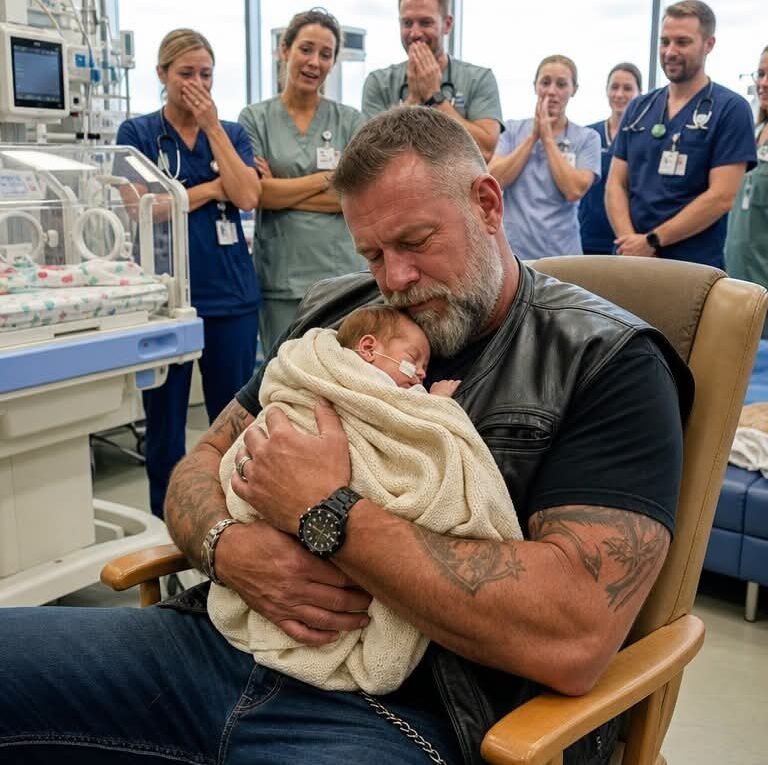
Nobody Could Understand Why a Tough-Looking Biker Refused to Put Down a Crying NICU Baby — Until the Name Tattooed on His Wrist Broke Everyone’s Heart

The Giant Volunteer in the NICU
The first time I saw Hank “Atlas” Mercer inside the NICU, I thought someone had walked into the wrong place.
I had been a nurse at Mercy Lane Children’s Hospital in Kansas City, Missouri, for nearly twelve years. I knew the quiet language of that unit better than I knew the sound of my own kitchen in the morning. I knew the soft beeping of monitors, the careful footsteps, the whispered prayers, and the way parents stood beside incubators as if love alone could teach a tiny body how to keep fighting.
But Hank did not look like anyone I expected to see there.
He was a white American man in his early fifties, six-foot-six, broad-shouldered, with a shaved head, a thick gray beard, faded tattoos on his forearms, and hands so large they looked as if they belonged around motorcycle handlebars, not a newborn smaller than a loaf of bread.
His black biker vest had been left outside the unit, exactly as the rules required. He wore a disposable blue hospital gown over his dark T-shirt, but the tattoos still showed near his collar and wrists.
Everything about him seemed too loud for that room.
The NICU was made of soft light, tiny blankets, clear plastic beds, warmers, feeding tubes, hand sanitizer, and babies whose cries could break your heart without filling the air.
Hank looked like an open highway during a storm.
Then the baby in bed six began to cry.
The Baby With No Visitors
Her chart did not have a full name yet.
For now, she was listed as Baby Girl Dalton.
She had arrived early, smaller than she should have been, and carrying a harder beginning than any child deserved. Her mother, Kayla Dalton, was young, overwhelmed, and dealing with problems that had taken more from her than most people understood. She had left the hospital before the paperwork was finished.
No father had signed in.
No grandmother had called.
No aunt had dropped off a blanket.
No little pink bag waited beside the incubator.
Some babies arrive with entire families crowding the hallway, asking nurses for updates every ten minutes. Some babies arrive with balloons, prayers, stuffed animals, and relatives arguing kindly about whose nose the baby has.
Baby Girl Dalton had none of that.
She had a hospital bracelet, a temporary name, and a cry that sounded far too tired for someone so new.
That morning, we had tried everything safe and appropriate. We dimmed the lights. We swaddled her carefully. We checked her feeding schedule, her temperature, her breathing, every small sign that mattered. We used every gentle method we knew.
Still, she cried.
Her little fists tightened under the blanket. Her face turned red. Her body stiffened, then trembled, then started again.
Hank turned his head toward the sound before I even finished introducing myself.
“Is that the baby who needs holding?” he asked.
I looked at his volunteer badge.
He had passed every background check. He had finished every hospital training session. He had been approved for our infant comfort program, where trained volunteers could sit with babies whose families could not be there.
Still, I looked at his hands.
They were huge, rough, and marked with old scars.
Not the hands I had imagined holding a fragile newborn.
“She is having a difficult morning,” I said gently.
Behind me, another nurse whispered, “That man?”
I pretended not to hear it.
Hank heard it.
But he did not turn around.
The First Hour

Hank washed exactly the way he had been taught.
He waited for every instruction. He sat in the approved rocking chair with his back too straight, his knees too high, and his arms open carefully, as if he was afraid one wrong movement could be too much.
When I placed Baby Girl Dalton against his chest, she cried harder.
A doctor paused near the doorway.
Two nurses looked over from the station.
Hank lowered his chin and whispered near the baby’s ear.
“Easy now, little sparrow. I’m not going anywhere.”
She cried for five more minutes.
Then ten.
Then twenty.
Hank did not shift impatiently. He did not ask if something was wrong. He did not look embarrassed. He simply breathed slower, deeper, steadier, letting his chest rise and fall beneath her tiny body.
His palm rested across her back with such care that I felt a quiet shame settle inside me.
I had judged him before he had even sat down.
At forty minutes, her cry softened.
At fifty minutes, her fists relaxed.
At one hour, Baby Girl Dalton was asleep against the edge of a tattoo peeking above his hospital gown.
For a moment, the entire room felt different.
Even the monitors seemed less harsh.
I stepped closer and kept my voice low.
“You can place her back if your arms need rest.”
Hank looked down at her tiny face.
“No, ma’am.”
“You do not have to hold her all day.”
His eyes shone, though he blinked quickly.
“I know how I look,” he whispered. “But she does not need pretty. She needs present. And I can be present.”
That was the first time I understood there was a story behind him.
I just did not know yet how deep it went.
Twelve Hours in One Chair
Hank had been scheduled for a short volunteer block.
Two hours.
Maybe three, if the unit stayed calm.
But Baby Girl Dalton slept best against him, and every time we prepared to move her back, her face tightened. Her fingers curled. A cry gathered in her chest like a small storm returning.
Hank would look at me and ask quietly, “Could I stay a little longer?”
At first, I said yes because it helped the baby.
Then I said yes because it helped the room.
The other babies rested better without her constant crying. Nurses could focus more easily. Doctors moved softer past bed six, as if they did not want to disturb something sacred.
Hank did not scroll on his phone. He did not complain. He barely spoke unless a nurse asked him a question.
By hour five, I brought him water.
“Your back must hurt,” I said.
He gave a small smile.
“My back has complained louder for smaller reasons.”
“You are allowed to take a break.”
He looked down at the sleeping baby.
“She took one first.”
By hour seven, his shoulder had gone stiff.
By hour nine, his leg had fallen asleep.
By hour eleven, his eyes were red from exhaustion.
Still, he stayed.
At hour twelve, Baby Girl Dalton was still sleeping, one tiny hand resting near a tattoo on Hank’s wrist.
The tattoo said AVA.
I noticed the way his thumb brushed near the letters without touching them.